Business After Capitalism
The prominent story told today about business is that worthwhile contributions to society are measured by how successful a business is and that money is the fundamental measure of that success. Meaning, if we wish to have any sort of meaningful society, we must run businesses that maximize the generation of money. The more money a business makes, the more important that business must be and therefore the more beneficial and integral it must be to society.
While I certainly agree that business has become an effective way to organize and distribute the needs of society, I contend that people are the fundamental building blocks of business; money is an arbitrary language for businesses to relate to one another; and that business is simply one format to organize the actions of people.
Organizing ourselves in ways that make products and services available to others is a smart thing to do. It is probably a natural, inevitable occurrence since part of our nature is to grow and find paths of least resistance. If we each spent hours or days every month asking around for someone to cut our hair, fix our cars, or where to find eggs, society would be terribly limited to any sort of experiential progress.
Similarly, if money hadn’t become the tool for so much irreparable corruption, we could probably keep this old capitalist system of ‘working for money to buy things’ and do very well as a civilization. Money itself is not corrupt. Money has never done anything in the history of its existence, and it never will. However, its use by humans has broken our society beyond repair, hence the need to approach our societal systems from a fresh perspective.
Rather than scrapping our entire business economy in favour of receding into the woods to re-establish trade or barter systems (which incidentally, is where today’s corrupt business environment got its roots), why not keep aspects of business that support human growth and learn from aspects that hold us back.
Welcome to Business After Capitalism; offering practical strategies that incentivize collaboration in business as a means to increase standards of living and usher in a new age of social potential.
Business is an integral part of society
Business has existed ever since the first time someone suggested “I’ll give you five loaves of bread if you build me a table”. I suppose it existed even earlier than that when someone suggested “…sure, you can marry my daughter, but I want fourteen of your best sheep out of the deal.”
The basic premise of trade has existed for ages. At some point in our civilizational history, marketplaces were established where customers and vendors could find one another in a somewhat organized and predictable manner. This eventually led to the industrial age with the advent of capitalism, resulting in many of the competitive practices used today.
Business and the use of money have been refined over the centuries into a well-oiled system widely accepted by the majority of the human population. Both money and business have been useful tools over this time. However, these tools have become out of order, and it is now incumbent on the current population to re-prioritize their use in ways that provide alternatives to the role business plays within society and the role money plays within business.
Business has been part of human civilization for thousands of years and it develops along with us. Each iteration of business (whether it was even recognized as being business or not) likely arose out of a legitimate desire to progress or find efficiencies. And as humanity evolves, so do the systems we invent. What might have been a sophisticated proposition at one time, inevitably becomes a primitive thought process. Even the solutions offered in this book will be viewed as dated one day.
Our competitive capitalist model has birthed many innovations over the years. It has lit a fire under a civilization to get beyond scarcity and it has brought about many incredible conveniences. It has also moved us beyond feudalism with the promise of equal opportunity for those who put forth an earnest effort.
On the other hand, it has brought terrible suffering to an unsuspecting population through poverty, the pursuit of war, and other inequalities. It has opened the door to power struggles rivalling the stories of ancient texts, ultimately leaving us with the possibility of annihilation if we don’t change our ways.
These two extremes, of rapid innovation and the potential for societal destruction, are not mutually exclusive. They seem to coexist in a delicate balance; the greater the advancements, the greater potential for their abuse.
Another way to say this is that the more freedom we create for ourselves, the more responsibility we must exercise. Like a child being allowed to ride their bike to the corner store if they promise to watch out for traffic.
The problem is society doesn’t have a trustworthy parent to manage this balance. We’re it. The “leveling up” of society is intertwined with the leveling up of each individual. In fact, the leveling up of our society is a response to the leveling up of ourselves since we are the only ones who devise and enact the functions of society.
As we develop as people, it becomes apparent to us that our previously devised systems are rudimentary and increasingly out of date. Liken to your younger years when you might have thought Rowdy Roddy Piper was the best wrestler. Now, having matured and looking back on the naivety of your childhood it’s plain to see that Hulk Hogan was far superior!
I’m kidding of course. But I hope you catch my drift. Our perceptions and actions tend to match our levels of awareness. As we mature the stuff we do follows along. And just like the maturing child, we must embrace this growth by leveling up ourselves as, not only the creators of more sophisticated business (and social) systems, but also be the responsible stewards of them.
If we don’t reconcile who we are becoming, the discrepancy between who we are and what we do will eventually get big enough for nature to force necessary changes; usually in the form of chaos, confusion, hardship, and turmoil. I call this leveling up ‘raising our baseline’ because of the increased standard of living that (externally) results from letting go of the past and embracing our increasing (internal) level of awareness.
This process will likely soften the peaks and troughs of society to a more level playing field too. Still balanced, but less extreme. And this process will also likely, unfortunately, leave some people behind who are unable or unwilling to grow up, as it were. Thus is the nature of evolution.
People (human species) are evolving
Business can be a terrific tool. We know how it works. It is accepted and there are countless educational programs, books, and other resources to learn and share business experiences. It is actually a terrific means for society to function.
However, somewhere along the way we lost focus on the reason we are doing business in the first place. Where once it was a system for community members to interact in an objective and efficient way, it has become our most prominent tool to exploit one another.
Today, with all the blatant corruption in business, pathways to a more advanced civilization are being almost forced to emerge. At one time, mergers, hostile takeovers, or coordinating international trade deals to launder money and arms to terror groups might have been seen as some kind of advanced, serious, movie worthy, business practice. But to most, these transactions just feel like old news. Sure, they may be complex scenarios that take a certain level of intellect and experience to manage effectively, but the meaning behind them – to amass wealth or instigate war for personal gain – is now recognized as primitive.
Consider the broader context of the natural world: individual atoms work together for the optimal function of the molecules they make up, individual molecules work together for the optimal function of a cell, individual cells work together for the optimal function of our bodies, and so on. Even on a cosmic scale, planets spin and orbit in ways that hold our solar system intact which, in-turn, maintain balance in the Universe.
Yet, despite this vast symbiosis around us to exemplify, somehow we still end up competing amongst ourselves for personal dominance. This conflict may stem from an underdeveloped ego that perceives itself as isolated from the whole, lacking the ability to comprehend responsibility and stewardship, let alone having acquired the ability to perform it.
It’s that immaturity as a civilization that has allowed business to become so corrupt, and is now hanging itself with its own greed. We lost our focus, got caught up in the game of accumulation; and at the expense of human welfare and the welfare of our natural environment.
If indeed, compassion and responsibility are results of maturity, then I suppose you can’t really fault an immature civilization for prioritizing material gain over human welfare, just like you couldn’t fault a child for their inability to empathize. A fledgling civilization values fast cars over spending the afternoon listening to and validating a neighbour’s dilemma, in the same way a child prefers their toy over appreciating their parent’s protection.
This certainly begs the questions: how old is our civilization?, and by what time scale should we measure our maturity? Personally, I find this a fascinating subject, but its exploration will have to be reserved for a different conversation. For now, let’s take the position that our collective humanity has reached an arbitrary time where our ability to recognize the value in more subtle aspects of society, like connection and friendship, has been reached.
This means we are at a crossroads in human development, where we have the potential to evolve into a more cooperative and unified species but have not yet attained it. This evolution is not driven by external forces like politics or financial incentives, but by a deep, internal desire to fulfill our individual purposes while supporting others in doing the same.
Of course, I don’t mean to overlook cultures, such as indigenous communities, who have figured out collaborative societal practices long ago. You might consider them the parents of humanity, to whom the rest of us children won’t listen until we’ve matured enough.
It’s time for those of us with sufficient awareness to learn (perhaps re-learn) the skills necessary to work collaboratively with one another and apply those skills within business.
***
From my experience practicing collaborative business techniques, my sense is that we may have an awkward go of it, at least to start. We’ve all grown up in competitive environments, from job interviews, to being picked for street hockey teams, to finding a date for prom. We are surrounded by competition. Even buying a home or vehicle is inherently competitive – “what’s the most I can afford?”, “I hope I get approved”.
As the human species evolves so do our social systems, and often with a period of lag. First the organism grows up then the stuff it does follows along. As humanity evolves now, it’s clear that the competitive business systems we had devised to organize ourselves are no match for who we are becoming (or have already become) as a society.
Competition in business likely would have been a sophisticated tool in times of scarcity, offering an alternative to brute force (literally) taking the cake. It also brought us to today’s abundance by dangling the prospect of a life of ease and prosperity to a wide population. Competition offered a motivation that pushed innovation to the point we see it today. For that, we thank it.
But now, at this stage of human evolution (and in an age of statistical global abundance), not only is competition in society unnecessary, it is a misalignment with who we are. And not only does competition in business not align with who we are, but also the environment that could once justify competition in business no longer exists. In short, we’ve grown up and our systems are due for an upgrade.
Competition, of course, is still part of human nature so we can’t disregard it completely. That would be naïve. So, in true collaborative fashion, Business After Capitalism incorporates certain aspects of competitive business systems as instruments to transition beyond it. If done well, and for the purpose of “upgrading” society, business can be an extremely powerful tool to move us from this current era of austerity and sacrifice into a new paradigm of sovereignty and abundance.
Priorities
I grew up around the automotive industry. My father was a mechanic and my buddies and I built dune buggies together. I became an apprentice mechanic eating fingerprint sandwiches, working two (sometimes three) bays at a time to make as much money as I could. I later became a sales guy at a parts warehouse making upwards of 250-300 calls per day. I was good at both of those jobs and enjoyed being good at them. But soon enough I realized there were only so many hours in a day, only so many parts to sell and only so many raises I could get; which meant there was only so big of a paycheque I would ever make.
At twenty-eight I attended college. It was a business program in the Outdoor Adventure industry. I figured if I couldn’t buy a great lifestyle then maybe I could live one while also accumulating money in the background. Out of college I became a wilderness guide working at resorts and private companies. I then started a guiding agency of my own and became the tourism board president representing hundreds of adventure tourism businesses before moving into the coordination of an international adventure film festival. My life was diverse, social, and grounded in nature. Yet – and such is the case with lifestyle industries – there was always so little money left over at the end of each month.
It was from these two, ten-year life experiences that I was enlightened to what could be called my tenure of business experience. By both chasing money to acquire an ideal life and chasing an ideal life to acquire money, I realized something interesting: either way you look at it, the weight our society assigns to aspects of business is fundamentally backward.
In the traditional capitalist model, business is structured around a hierarchy that prioritizes money generation above all, then production, business operations, and finally the satisfaction of people. Yet, a natural human progression would see people, their actions, and how they organize themselves come first, with money being a secondary concern. Only in rare cases are lifestyle and money generation balanced.
This may seem like a painfully apparent assertion but, like tossing a pebble into a pond, even though the pebble may be obvious, it’s how the pebble affects the pond that holds meaning.
When I embraced the significance of this subtle shift in perspective – from pebble to ripples – I saw business and society in a new light. It began to make sense. The connections between business, money, people and production became clear.
“If you look at society through the eyes of a business plan, suddenly it all starts to make sense”.
Ray Bretzloff
Let me ripple out some examples to explain what I mean.
One revelation that came to me is that money is not fundamental to business (as stated earlier). Business has nothing to do with money. But money does have everything to do with business.
Another way to say this is that businesses, projects and community events can all operate just fine without money, but money relies 100% on these initiatives happening. Money is completely dependent on business. Money on its own is moot, irrelevant, and (punily enough) holds no value of its own. Without a business to use money it has absolutely no function. It’s only when businesses wield this lifeless paper that it appears to be the lifeblood of society.
Furthermore, money cannot drive trucks, it cannot pull levers, it cannot make sales calls, it cannot coordinate teams, it cannot come up with the next revolutionary idea and it certainly is not aware of its existence. Money is merely a tool of business; business is merely a tool of people, and it's what people do (with or without business) that defines our society.
Money is the least foundational aspect to business, yet the majority of business books, seminars, and teachings you’ll find on business today centre around money. Why is that?
Focusing on money to build a business is akin to focusing on the pebble while ignoring the hand that threw it. Or focusing on lumber when constructing a house. Without people to measure, cut, and assemble the lumber, it remains an inert pile of wood. And when you think of it, a house (or any other edifice) could be built with any number of materials, beholden only to the ingenuity of the builders.
A second important ripple I noticed from capitalism’s topsy-turvy priorities is that a business and what that business does are not the same. Business is its own game, separate from what the business is built around. For example, coffee could be roasted whether it is part of a business or not, but a business cannot exist unless coffee is being roasted.
The business is 100% fully dependent on your ability to roast coffee but your ability to roast coffee relies exactly 0% on the success of the business. In the same way that money needs business but business does not depend on money, business needs human effort but human effort does not depend on business.
Somehow, in society we’ve allowed the lesser to be elevated beyond its true position, the sub-erior above the sup-erior. Like allowing children to run the household while the adults follow orders.
Business is a common structure, and money is a common tool. But neither are fundamental to producing anything in the world, nor are they integral to leading a fulfilling life.
The only exception where money does break ranks is in the banking world. While other businesses are built upon human effort to produce furniture, fix cars, grow food, offer guidance, or teach others; to banks, money is their product. People organize themselves into businesses (banks) to create and exchange money.
From the bank’s perspective it has no choice but to peddle money. It’s their product. But for everyone else, we have options. We are not bound to money. However, we are bound to having some sort of structure if we want people to sit in our chairs, visit our restaurants, enrol in our classes, or purchase our books with any type of consistency. To create these things for your own pleasure is terrific, but to attract others to your unique offering needs some kind of planning and organization.
Who is this book for?
It would be reasonable to think the personality profile of someone drawn to collaborative, people-centric business practice would include more than being impressed by a Master’s Degree in business. It would be more likely those who are ushering in new people-centric business (and social) paradigms are not impressed by these accreditations at all, but instead revere skills relevant to the future we are building – societies built upon collaboration, compassion, and personal awareness.
Business After Capitalism will likely resonate most with people who are rooted in reality, who want to spend time with others who are grounded, and who choose to organize themselves around common and complimentary interests and expertise.
Business is a learned skill. Whether it be competitive, money-centric, or collaborative, people-centric, the activity of business is not coded into our DNA. It is an acquired ability like playing sports or a musical instrument. A skill that must be developed.
The spirit of entrepreneurship, however, naturally lives in many people. And so, this book was written for those who lean towards benevolence and generosity, who have something to share with the world, and who feel business could be a vehicle to help accomplish their goals. Holding an MBA, in these cases, is icing on the cake.
There is a lot of freedom that comes with entrepreneurship. Freedom to make decisions and experiment. Creative freedom. Time freedom. It’s a much more elegant way of life not being boxed into Doozerdom, repeating repetitive tasks for forty years.
But like everything there is a balance. The freedom that comes with running your own business is equaled by being responsible for it. The freedom that no one is forcing you to do something is balanced by the responsibility that no one else will do it for you. “I don’t really have to do this today…but it has to get done…but I suppose I don’t have to…but yes I do…but no…yes.”
Are you Sophia?
Business After Capitalism’s ‘Ideal Reader’ profile is: New Entrepreneurs or Small Business Owners who are drawn to Community. More specifically, the contents of this book are intended to help entrepreneurial personalities become more comfortable with collaborative and people-centric business tactics, strategies, and approaches if you:
Have a project idea – or – have an existing business that’s become stagnant, and
Are drawn to collaboration and community – or – are repelled by competing against your neighbor for an extra buck.
Furthermore, BAC’s ‘Ideal Reader’ is a specific niche within Activate Us’ (the publisher of this book) ‘Ideal Follower’ profile who:
Knows they have more to offer the world, and
Is ready and unafraid to explore what that may be.
We named this personality Sophia and even wrote a short story about her realization that she is worth more than simply ‘working to survive’. You are welcome to jump ahead to read the Sophia Story (in the appendix) first if you’d like to gain a deeper sense of where we’re coming from and who we’re speaking to.
The Sophia Story is also an elaborate example of knowing your ideal customer in a people-centric business environment. (Yes, some traditional capitalist business planning strategies are still quite useful.)
Ultimately, the overlap between awareness and action is where both of these (fictional) Ideal Profiles reside. They are both very entrepreneurial in that respect. If any aspect of your own personality identifies with BAC’s Ideal Reader profile or Sophia it is very likely you’ll find these pages both enjoyable and beneficial.
Entrepreneurial Action
Collaborative, people-centric business is not solely an academic exercise. It isn’t enough to merely learn of these concepts if we indeed want to advance our civilization using the medium of business. We must also implement, as best we can, from a place of thoughtfulness and foresight, balancing the freedom of entrepreneurial business with the responsibility of stewardship.
I don’t mean to assume every reader will start a business, nor will every strategy be implemented if you do. However, BAC was written with the intention to practice these concepts in real world settings. And since business is such a big part of today’s world, we must participate if we are to affect its change.
Society is a big ship to turn. Abandoning capitalism tomorrow morning in favour of jumping to a utopian society without the accompanying emotional and practical skills would be silly. Not to say it isn’t possible to snap our collective fingers and instantly materialize an advanced civilization (that’s a practice for another workshop!), I just mean in practical terms it will take a fair bit of sustained effort to bring our business and social systems up to speed, lest we get overwhelmed and fall back on what we’re used to.
Business isn’t a new concept. We all have some basic level of business knowledge, if not experience. In this book, some of the more obscure capitalist tactics are described with additional detail (often to highlight their antiquated obscurity) while other more commonly known business strategies focus on describing how we may repurpose them for more collaborative and people-centric outcomes.
Humanity is at the cusp of initiating new business and social systems to, not only catch up with an emerging level of human awareness, but also to keep pace as we continue to evolve. These pages offer tools to help each of us enact our people-centric propensities, collaborative communities, and entrepreneurial inclinations.
This Book is…
This book is by no means the final draft of what collaborative business may look like in the future, nor is it the first. Frederic Laloux’s book Reinventing Organizations, for example, is a terrific documentation of companies around the world who have been quite successful adopting various collaborative business practices.
One common theme reported throughout his book is how the efficiencies in collaboration have resulted in an increase in benefits typically sought-after by competitive business. Benefits such as increased revenues, decreased expenses, expedient and more accurate decision-making, and improved customer satisfaction and retention, to name a few. I’m sure we can all imagine how much more powerful collaboration would be over competition and these companies offer empirical data to prove it.
This puts collaborative business practice in a unique position by appealing to both collaborative and competitive entrepreneurs. A collaborative entrepreneur would naturally prefer collaborative practice because it suits their personality, while also offering increased benefit over competitive practice. A competitive entrepreneur, however, would be faced with a choice; to either learn to become collaborative to acquire this increased benefit or stay true to their competitive personality, sacrificing a portion of potential benefit.
Since maximizing benefit (profit) is the paramount reason for competitive capitalist businesses to exist at all, competitive entrepreneurs may find themselves at a crossroads. This is a beautiful irony about collaborative business; that it wins in competitive arenas even though it’s not competing.
Another, not-so-efficient, theme from Laloux’s book is how each case study relied on the head of the company to initiate and preserve their organization’s collaborative practices. There was even an instance where one company reverted back to standard competitive tactics when the CEO left the organization.
This is where Business After Capitalism picks up the baton. By offering ways to integrate collaborative strategies into everyday business practice, we are able to keep the increased benefit aspect of collaboration while removing the dependency on individuals to champion a novel business practice. BAC makes collaborative business practice both desirable and easy to implement.
This relay from Reinventing Organizations to Business After Capitalism is also an instance of collaboration because we are building upon previous efforts. And it would be reasonable to think that someone reading this book will one day be inspired to innovate these philosophies, strategies, and practices further and to write their own book about the next iteration of collaborative business. That book might reference us, which I have referred back to Frederick Laloux, who refers back to each CEO he interviewed, who probably reference their mentors, when asked.
Systemic and incentivized use of collaborative business practice also opens the door for collaboration among businesses, not only within businesses. The increased benefit experienced by a single organization is expounded when leveraging the collaboration of multiple, complimentary businesses speaking the same language, so to speak.
Similar to how competitive capitalist businesses are able to relate to one another with common terminology, tactics, and techniques and by viewing their business’ purpose and outcomes through a similar lens, collaborative, people-centric businesses are also able to relate to one another on their own common “platform”.
Just as the latest version of an app running on an upgraded operating system releases more of its potential, businesses running on an upgraded collaborative, people-centric “operating system” may release more of their potential.
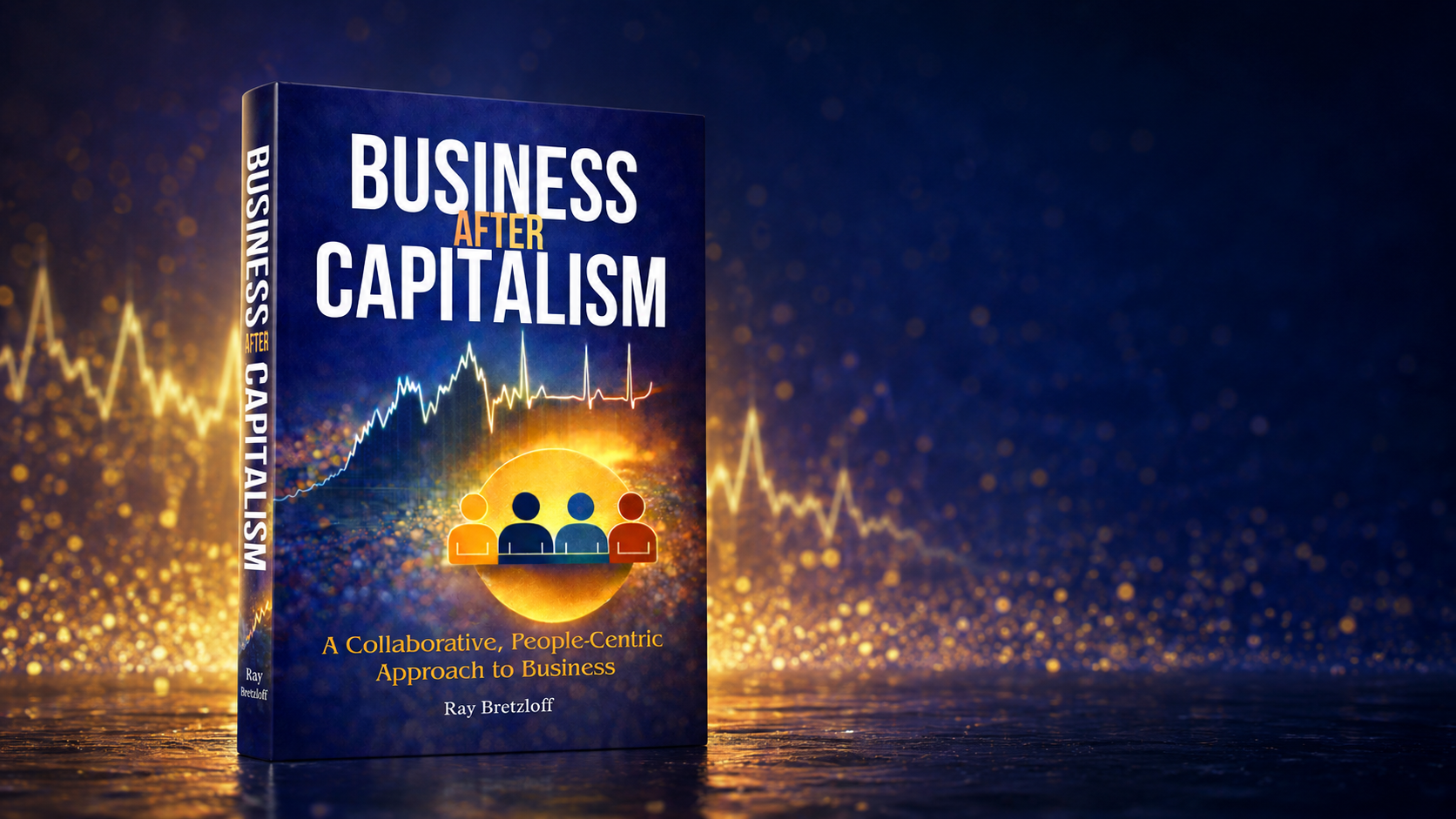
Business After Capitalism
Purchase your print copy of from the Lulu print-on-demand bookstore.